THE BIG BANG
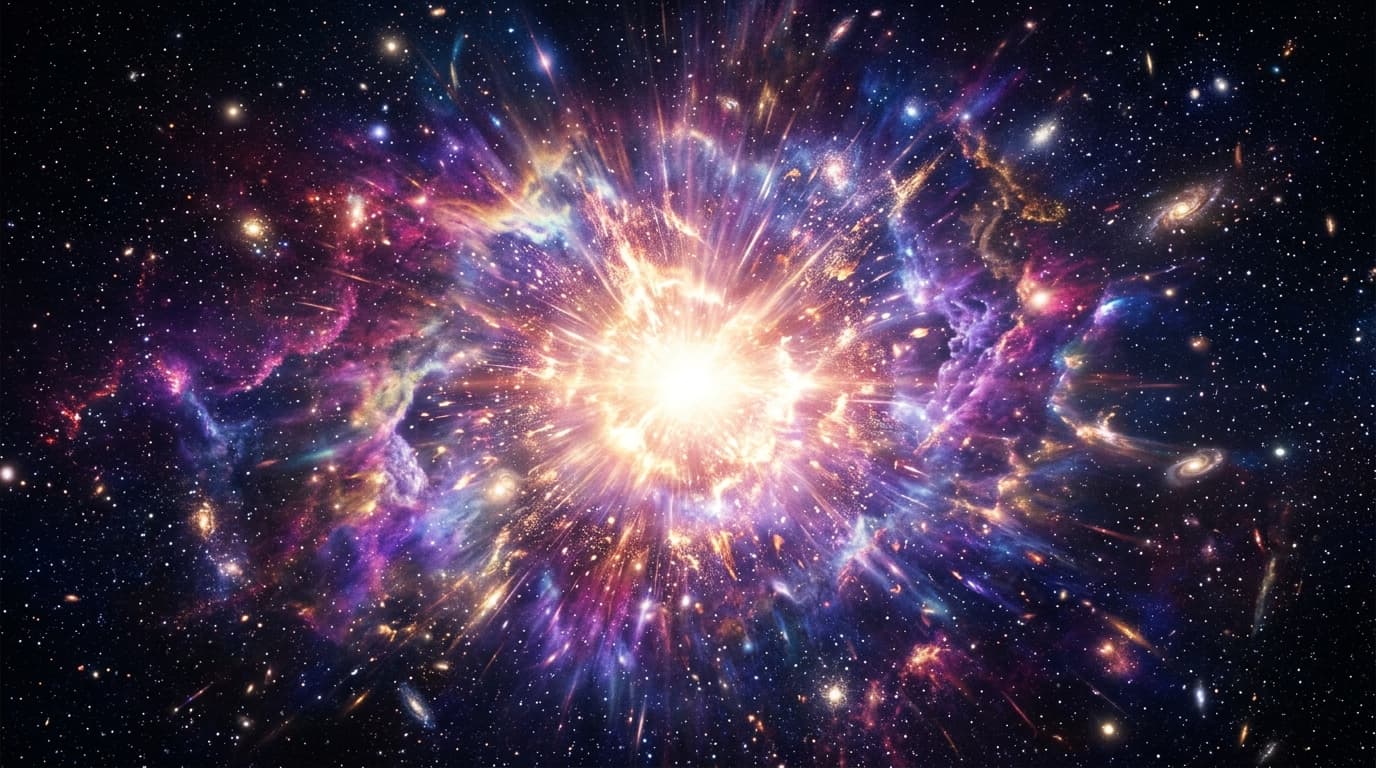
13.8 billion years ago, the universe exploded from an infinitely dense, hot point. Not an explosion in space, but an expansion of space itself.
Timeline of the Universe
Trace the stages of the cosmos from the subatomic fury of the first microsecond to the formation of galaxies, stars, and life.
Planck Epoch
The earliest possible period of the universe. At this scale, the fabric of space and time is a foam-like quantum structure. All four fundamental forces of nature—Gravity, Electromagnetism, Strong Nuclear, and Weak Nuclear—are unified into a single, super-force.
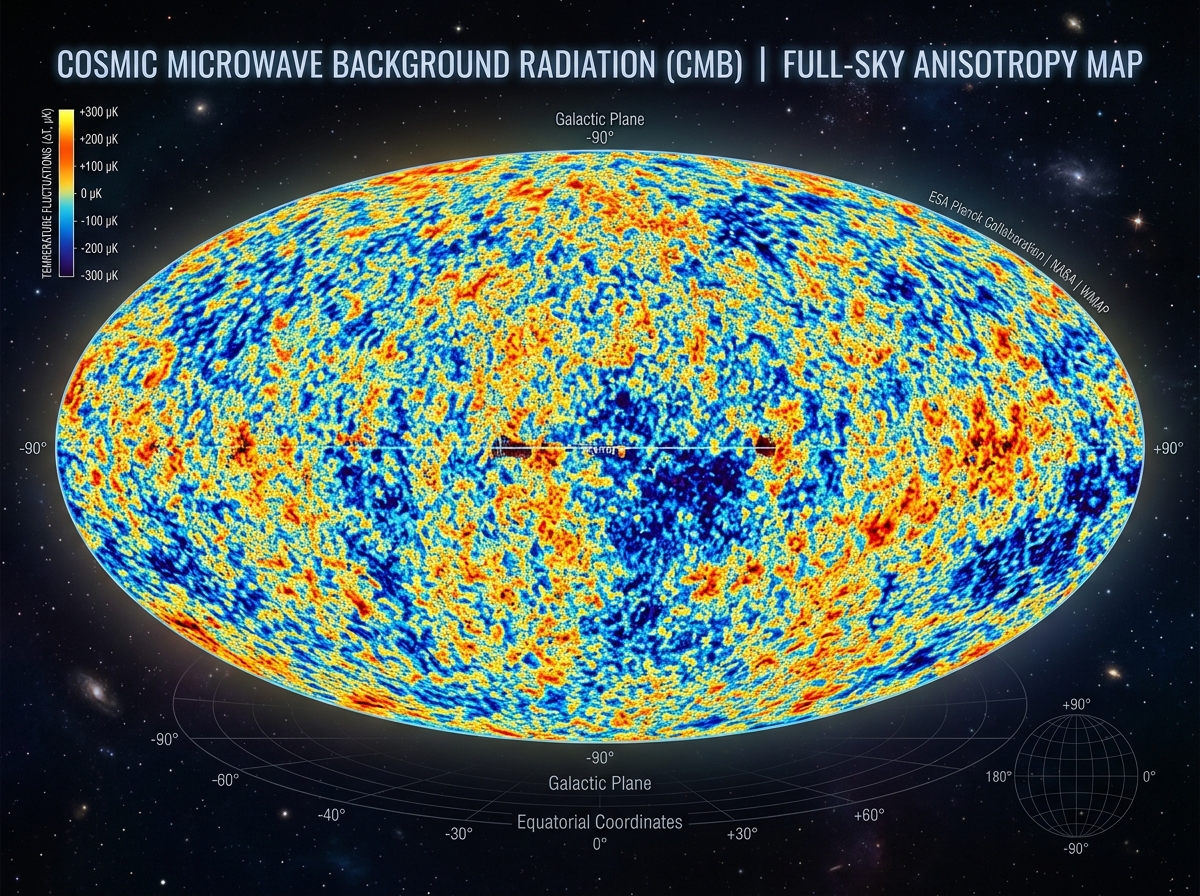
Cosmic Microwave Background (CMB)
The CMB is the oldest light in the universe, imprinted onto the sky when the universe was just 380,000 years old. Before this, space was a dense, opaque plasma of electrons and protons trapping all light.
As the cosmos expanded and cooled below 3,000K, electrons bound to protons to form neutral hydrogen (Recombination). Light escaped, traveling freely through space. These photons have been stretched by cosmic expansion into the microwave spectrum today.
Explore the CMB Sky Map:
Hover over the sky map on the right. Observe how telescope resolution and anisotropy scales reveal the thermal structure of the early universe.
The Three Pillars of Evidence
How do we know the Big Bang actually happened? Cosmology rests on three solid, independent observational pillars.
1. Expansion of the Universe
In 1929, Edwin Hubble observed that light from distant galaxies is shifted toward the red end of the spectrum (redshift). This proves that galaxies are moving away from us. Reversing this cosmic expansion points to a single starting point in the past.
2. Cosmic Microwave Background
Predicted in the 1940s and discovered in 1964, the CMB is the relic heat of the baby universe. It consists of the first photons that escaped plasma traps during recombination. No other cosmic theory can explain its perfect blackbody spectrum.
3. Light Element Abundance
The early hot cosmos acted as a massive fusion reactor. Mathematical nucleosynthesis models calculate the universe should contain 75% Hydrogen, 25% Helium, and trace Lithium. Observational measurements of pristine gas clouds match this model exactly.
Cosmological Simulator
Manipulate fundamental physical forces of gravity and dark energy to observe how they influence cosmic expansion and orbital planetary accretion.
Cosmic Simulator
Click to trigger the Big Bang explosion and simulate gravity clumping and planet accretion.
Tuning Parameters
Scenario Presets:
Frequently Asked Questions
Cosmology can be mind-bending. Here are answers to some of the most common questions about the Big Bang.
According to general relativity, the Big Bang was the origin of space and time themselves. Therefore, asking what happened "before" the Big Bang is like asking "what is north of the North Pole?" Time did not exist as a physical dimension before this event. However, advanced theoretical physics models, such as String Theory and Loop Quantum Cosmology, suggest our universe might have emerged from a pre-existing "multiverse" or collapsed from a prior universe in a "Big Bounce."
The Big Bang did not happen at a single point in space. It happened everywhere at once. The Big Bang was not an explosion of matter in pre-existing space, but rather the rapid expansion of space itself. Every point in the universe today was once compressed into the initial singularity. Therefore, the Big Bang occurred at every location in the universe simultaneously.
The universe is not expanding "into" anything. It does not require a surrounding space to expand into. The universe is self-contained. When cosmologists say the universe is expanding, they mean that the distance between galaxies (or coordinates of space) is increasing over time. The fabric of space itself is stretching, but it isn't pushing into empty external space.
We determine the age of the universe through two main methods. First, by measuring the rate of expansion (the Hubble Constant) and the density of matter and dark energy using spacecraft like the ESA Planck mission, we can run the mathematical equations of general relativity backward to find when size was zero. This yields 13.787 ± 0.020 billion years. Second, we can verify this by estimating the ages of the oldest stars (in globular clusters) and radioactive element decay, which are consistently slightly younger than 13.8 billion years.
The ultimate fate depends on the amount of dark energy and matter in the cosmos. Currently, measurements suggest that dark energy dominates, causing the expansion of the universe to accelerate. If this continues, the universe faces a "Big Freeze" (or Heat Death), where stars run out of fuel, galaxies drift too far apart to interact, and the universe becomes a cold, dark, maximum-entropy state. Other possibilities include a "Big Rip" (where dark energy tears atoms apart) or a "Big Crunch" (if gravity eventually reverses expansion).